


Come, Thou Fount of Every Blessing
The Timeless Hymn of Grace, Gratitude, and God’s Faithfulness
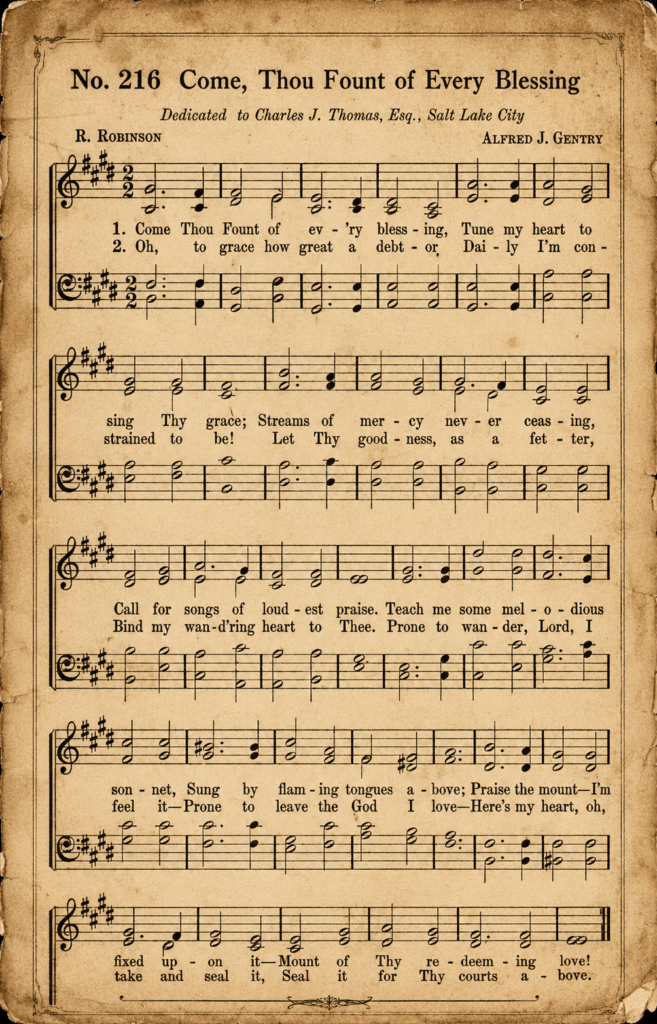
Full Lyrics:
| Come, Thou Fount of every blessing, Tune my heart to sing Thy grace; Streams of mercy, never ceasing, Call for songs of loudest praise. Jesus sought me when a stranger, Wand’ring from the face of God; He, to save my soul from danger, Interposed His precious blood. O to grace how great a debtor Daily I’m constrained to be! Let that grace, Lord, like a fetter, Bind my wand’ring heart to Thee. Teach me, Lord, some rapturous measure, Meet for me Thy grace to prove, While I sing the countless treasure Of my God’s unchanging love. Prone to wander, Lord, I feel it; Prone to leave the God I love: Take my heart, oh, take and seal it With Thy Spirit from above. Rescued thus from sin and danger, Purchased by the Savior’s blood, May I walk on earth a stranger, As a son and heir of God. |
Among Latter-day Saints, few hymns have inspired as much affection—and as much discussion—as Come, Thou Fount of Every Blessing. Several years ago, I recall encountering a survey suggesting that two of the most beloved hymns among Church members were I Stand All Amazed and Come, Thou Fount of Every Blessing. While I have not been able to locate that survey in recent years, the latter result is particularly intriguing because Come, Thou Fount does not appear in the current English hymnbook of The Church of Jesus Christ of Latter-day Saints.
With the ongoing interest surrounding the forthcoming hymnbook revision, many members have expressed hope that the hymn might once again find a place in official worship. This raises several interesting questions: What role has Come, Thou Fount of Every Blessing played in Latter-day Saint hymnody? Why was it omitted from the current English hymnbook? And what is its status in hymnbooks published in other languages throughout the Church?
Early Inclusion in Latter-day Saint Hymnody
Written by Robert Robinson and first published in 1759, Come, Thou Fount of Every Blessing quickly became a cherished hymn among English-speaking Christians. Although the original tune associated with the text remains uncertain, the melodies NETTLETON in the United States and NORMANDY in the United Kingdom eventually became the most commonly used settings.
The hymn first entered Latter-day Saint worship through A Collection of Sacred Hymns for the Church of Jesus Christ of Latter Day Saints, published in Nauvoo in 1841. This volume represented an expanded edition of Emma Smith’s 1835 Kirtland hymnbook and served as one of the earliest official hymn collections of the Church.
However, the Nauvoo hymnal existed alongside another influential collection produced by the Quorum of the Twelve Apostles in Manchester, England. Following the death of Joseph Smith and the subsequent divisions within the Latter Day Saint movement, the Manchester hymnbook gradually became the standard collection among the Saints who migrated west to Utah. Because Come, Thou Fount had not been included in the Manchester editions, the hymn largely disappeared from mainstream Latter-day Saint worship during the latter half of the nineteenth century.
Return Through the Sunday School Movement
The hymn re-emerged in 1909 through Deseret Sunday School Songs, one of the most widely used musical collections in early twentieth-century Latter-day Saint culture. This edition featured a dignified musical setting composed by Alfred J. Gentry rather than the now-familiar NETTLETON tune.
For nearly four decades, Deseret Sunday School Songs functioned alongside the Church’s official hymnbooks and became a significant part of congregational worship. When the Church introduced a new unified hymnbook in 1948, Come, Thou Fount was included once again. This time, however, it appeared with the NETTLETON melody that remains closely associated with the hymn today.
The revised 1950 edition continued in use until 1985, when the current English hymnbook was published.
Why Was the Hymn Omitted in 1985?
The absence of Come, Thou Fount of Every Blessing from the 1985 hymnbook has long puzzled many Church members.
According to individuals involved in the compilation process, the primary reason was relatively straightforward: the hymn was not considered particularly popular at the time. Committee members reportedly believed that it was sung infrequently and would likely fade from memory if omitted from the new collection.
Other factors may also have played a role. During the hymnbook revision process, some committee members expressed a desire to emphasize hymns that more explicitly reflected distinctive Latter-day Saint doctrines and teachings. One participant described the goal as including songs that would “proclaim the revealed truth in this day and time,” resulting in fewer hymns drawn from broader Protestant traditions.
Viewed in this context, the omission becomes easier to understand. Several uniquely Latter-day Saint hymns—some of which were relatively obscure—were retained because of their doctrinal significance within the Church. By contrast, Come, Thou Fount originated outside the Restoration tradition and focuses primarily on themes of grace, redemption, and personal devotion that are common throughout Christianity.
Regardless of the specific reasoning, the hymn was left out of the 1985 collection. Yet rather than disappearing, its influence would soon grow dramatically.
The Mack Wilberg Revival
A major turning point came in 1994 when composer and arranger Mack Wilberg created a new choral arrangement of Come, Thou Fount of Every Blessing for the televised concert Thanksgiving of American Folk Hymns.
The arrangement was immediately embraced by audiences and soon became one of the most beloved pieces in the repertoire of the Tabernacle Choir. Through repeated performances, recordings, and broadcasts, the hymn gained renewed visibility and affection among Church members worldwide.
In many ways, Wilberg’s arrangement transformed the hymn from a largely forgotten selection into a modern Latter-day Saint favorite. Today, Come, Thou Fount is one of the rare hymns not included in the official English hymnbook that nevertheless appears regularly in sacrament meetings, special musical numbers, and even General Conference broadcasts.
Some congregations have gone so far as to insert printed copies of the hymn into their hymnbooks for convenient congregational use. Surveys and informal polls consistently place it among the most frequently requested additions to future hymnbook editions.
Growth Beyond the English Hymnbook
Ironically, while Come, Thou Fount remains absent from the English-language hymnal, it has steadily gained ground in international editions.
The hymn first reappeared in an official Church hymnbook in the 1996 German edition, published only two years after Wilberg’s arrangement debuted. Since then, it has been included in an increasing number of translated hymnbooks around the world.
Today, the hymn appears in multiple language editions published by the Church, representing a significant portion of its global hymnbook catalog. Interestingly, the number of verses varies among these editions. Some translations include only two verses, while others retain three or even four.
This growing international presence suggests that Come, Thou Fount occupies an increasingly important place within the broader musical culture of the worldwide Church.
Conclusion
The history of Come, Thou Fount of Every Blessing within Latter-day Saint worship has been anything but straightforward. Introduced in the Nauvoo period, absent for much of the nineteenth century, revived through Sunday School songbooks, omitted from the 1985 English hymnal, and ultimately rediscovered through Mack Wilberg’s celebrated arrangement, the hymn has experienced a remarkable journey.
Today, it enjoys a level of popularity that few could have predicted forty years ago. Whether this renewed affection will ultimately lead to its inclusion in the forthcoming core hymnbook remains to be seen. What is clear, however, is that Come, Thou Fount of Every Blessing continues to resonate deeply with Latter-day Saints around the world, securing its place as one of the most beloved hymns in modern Church culture.