



I Love to Tell the Story: A Gospel Anthem of Passion and Purpose
“I love to tell the story of unseen things above, of Jesus and His glory, of Jesus and His love.”
Few hymns capture the infectious joy of the Christian faith quite like I Love to Tell the Story. Written in 1869 by Katherine Hankey, this hymn serves as a vibrant declaration that the Gospel is not merely a set of doctrines to be studied, but a dynamic story to be shared. It is an anthem for those whose lives have been transformed by grace and who find that their greatest delight is simply recounting that love to others.
The Origin: A Story of Personal Devotion
The history of this hymn is as moving as the song itself. Katherine Hankey, a young woman from a wealthy British family, spent much of her life dedicated to ministering to the sick and the marginalized. In 1866, while recovering from a serious illness, she wrote a long poem detailing the life of Jesus.
Little did she know that this poem would eventually be divided into two separate hymns: Tell Me the Old, Old Story and I Love to Tell the Story. The latter was written as a personal testimony—a reflection of the joy she felt whenever she spoke of her Savior. When William G. Fischer later composed the upbeat, spirited melody, it perfectly matched the enthusiasm of Hankey’s words, turning a private meditation into a global call to evangelism.
The Theology of Proclamation: Why We Tell
The hymn identifies “telling the story” as the primary response to experiencing God’s love. It suggests that our faith is incomplete if it remains locked within our own hearts.
1. The Power of “Unseen Things”
“Of unseen things above, of Jesus and His glory.” We live in a sensory world that demands physical proof. Yet, Hankey reminds us that the most significant realities—God’s love, His presence, and His glory—are spiritual. Telling the story is our way of making these “unseen things” visible to a world that is desperate for meaning.
2. A Remedy for the World’s Weariness
“To those who know it best, it seems hungering and thirsting to hear it like the rest.” This is the hymn’s most profound insight. We often assume that the Gospel is only for those who have never heard it. But Hankey argues that the story is so rich that even those who have known it for years are constantly “hungering and thirsting” to hear it again. The story is not just a gateway to faith; it is the daily bread that sustains it.
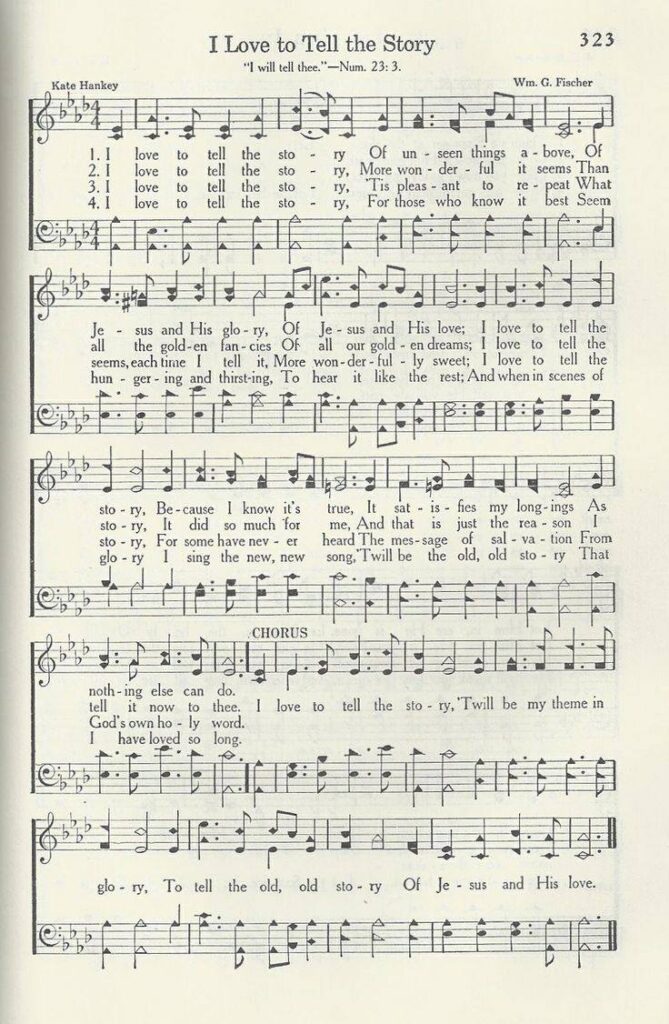
Lyrics: A Testimony of Joy
| 1. I love to tell the story Of unseen things above, Of Jesus and His glory, Of Jesus and His love. I love to tell the story, Because I know ’tis true; It satisfies my longings As nothing else can do. I love to tell the story, ’Twill be my theme in glory To tell the old, old story of Jesus and His love. 2. I love to tell the story; More wonderful it seems Than all the golden fancies Of all my golden dreams, I love to tell the story, It did so much for me; And that is just the reason I tell it now to thee. 3. I love to tell the story; ’Tis pleasant to repeat What seems each time I tell it, More wonderfully sweet. I love to tell the story; For some have never heard The message of salvation From God’s own holy Word. 4. I love to tell the story; For those who know it best Seem hungering and thirsting To hear it like the rest. And when, in scenes of glory, I sing the new, new song, ’Twill be the old, old story, That I have loved so long. |
Living the Story in a Modern Context
In the 21st century, the word “evangelism” can feel daunting, often associated with pressure or rigid debate. I Love to Tell the Story reframes this entirely: it is not about winning an argument; it is about sharing a joy.
- Make it Personal: Notice that Hankey uses the phrase “it did so much for me.” Sharing your faith is most effective when it is a testimony of your own transformation.
- Keep it Simple: The hymn calls it the “old, old story.” You do not need complex theological terminology. You only need to share how Jesus has met you in your own life.
- The Theme of Glory: The chorus mentions, “’twill be my theme in glory.” This reminds us that our earthly conversations are rehearsals for eternity. The story of Jesus is the one theme that will never grow old, even in heaven.
The Story That Never Ends
I Love to Tell the Story endures because it resonates with the core desire of every human soul: to be loved and to be known. When we share the story of Jesus, we are offering that same love to others.
As you go about your week, look for opportunities to share a snippet of “the story.” It might be a word of encouragement to a coworker, a testimony of God’s provision to a friend, or simply the way you carry yourself through a difficult situation. Your life is a living chapter in the greatest story ever told.