


O Come, All Ye Faithful: A Triumphant Invitation to the Incarnate Word
In the vast landscape of sacred music, few hymns possess the enduring power and liturgical majesty of “O Come, All Ye Faithful” (Adeste Fideles). More than a seasonal carol, it stands as a theological monument—a clarion call that has transcended centuries to beckon the hearts of the faithful toward the Manger. To sing this hymn is to participate in an ancient, sacred dialogue, an invitation to witness the most profound mystery of the Christian faith: the Incarnation of God in human form.
1. The Theological Grandeur of Adeste Fideles
The brilliance of O Come, All Ye Faithful lies in its unwavering focus on the divinity of Christ. While many Christmas carols focus on the rustic scenery of Bethlehem, this hymn focuses on the Adoration. It is a direct summons to the “faithful”—those whose hearts are tethered to the truth of the Gospel—to come, behold, and worship.
The repeated refrain, “O come, let us adore Him,” serves as the liturgical heartbeat of the hymn. It is an active, imperative command that moves the worshipper from passive observation to active participation.
2. The Sacred Lyrics: A Hymn of Coronation
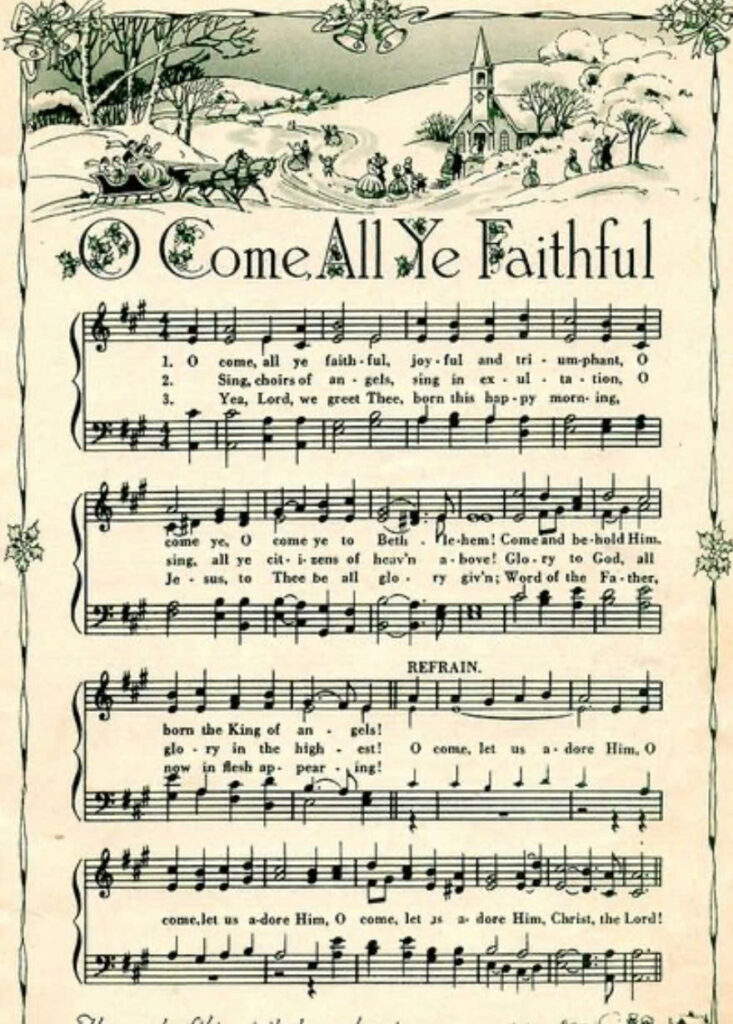
O come, all ye faithful, joyful and triumphant, O come ye, O come ye to Bethlehem; Come and behold Him, born the King of angels; O come, let us adore Him, O come, let us adore Him, O come, let us adore Him, Christ the Lord.
God of God, Light of Light, Lo, He abhors not the Virgin’s womb; Very God, begotten, not created; O come, let us adore Him, Christ the Lord.
Sing, choirs of angels, sing in exultation, Sing, all ye citizens of heaven above! Glory to God, all glory in the highest; O come, let us adore Him, Christ the Lord.
3. Depth and Sacred Significance
The Call to the Triumphant
The opening line addresses the faithful as “joyful and triumphant.” This is a profound theological statement: our joy is not contingent upon earthly circumstances, but upon the triumph of the Incarnation. Even in the midst of a fallen world, we are “triumphant” because the King of Angels has arrived.
The Doctrine of the Incarnation
The second stanza is perhaps one of the most powerful summaries of the Nicene Creed ever set to music. By declaring Christ as “God of God, Light of Light,” the hymn reinforces the dogma that Jesus is truly Divine. The line “lo, He abhors not the Virgin’s womb” is a staggering meditation on the humility of God—that the Creator of the universe would clothe Himself in human flesh to dwell among His creation.
The Liturgical Invitation
The hymn acts as a bridge between earth and heaven. By calling upon the “choirs of angels” and “citizens of heaven,” the hymn reminds us that when we worship, we are never truly alone. We are joining in a cosmic anthem that has been echoing through eternity.
4. Why This Hymn Remains Unrivaled
O Come, All Ye Faithful endures because it lacks the “sentimentalism” often found in modern holiday music. It is rugged, majestic, and demanding. It calls for a response.
- Universality: Its message transcends denominational divides, focusing on the core pillar of Christian faith: Christ as Lord.
- Majesty: The melody—attributed by many to John Francis Wade—is characterized by wide intervals and a stately rhythm that naturally demands a full, resonant voice. It is a hymn that feels “large,” designed to fill the vast acoustics of a cathedral.
- The Focus on Worship: At its core, the hymn is not about our feelings; it is about His worthiness. The repetition of the invitation to “adore Him” strips away our distractions and anchors our attention on the Manger.
5. Integrating the Hymn into Your Spiritual Life
- A Daily Benediction: Do not wait for December to sing this hymn. Reciting the lyrics during times of personal prayer can serve as an anchor, reminding you that the “King of Angels” is present in your daily struggles and joys.
- A Posture of Adoration: When you sing “O come, let us adore Him,” try to physically manifest that posture—whether through bowed heads, uplifted hands, or a moment of intentional silence. Let the words be a bridge to your interior life.
- Meditative Reading: Treat the hymn as a scripture reading. Spend time contemplating the weight of the words “Very God, begotten, not created.” Let these truths shape your understanding of who Jesus is and what His coming means for your life.
To sing O Come, All Ye Faithful is to join a procession of saints that spans centuries. It is an act of standing at the threshold of Bethlehem, witnessing the light that pierces the darkness of the world. It reminds us that our faith is not merely a set of beliefs, but a relationship with a God who loved us enough to become one of us.
May your heart always be among the “faithful,” ready to journey to the manger, ready to behold the King, and always, always ready to adore Him.
In the silence of your own heart, how does the realization of the Incarnation—that God truly became man—change the way you approach your daily life and your relationship with Him?