


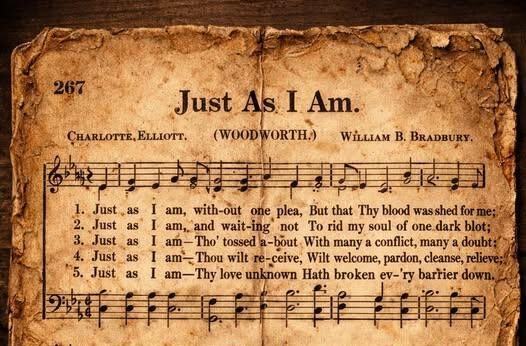
Just As I Am
There are hymns that inspire, and there are hymns that disarm. “Just as I Am” belongs to the rare second category. It does not demand that we arrive polished, theologically articulate, or emotionally composed. It simply opens a door and says: Come. No credentials required. No mask to wear. No performance to sustain.
In an age that prizes curated selves and spiritual self-improvement, this 19th-century hymn remains quietly subversive. It insists that the only qualification for approaching the Lamb of God is the honest acknowledgment that we have nothing to bring but our need.
The Lyrics
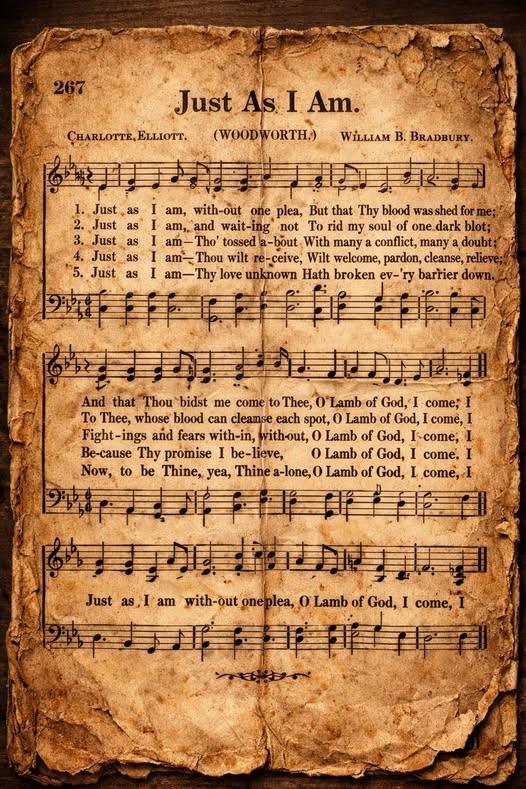
Just as I Am Charlotte Elliott, 1835 Music: William B. Bradbury, 1849
| Just as I am, without one plea, But that Thy blood was shed for me, And that Thou bid’st me come to Thee, O Lamb of God, I come! I come! Just as I am, and waiting not To rid my soul of one dark blot; To Thee whose blood can cleanse each spot, O Lamb of God, I come, I come! Just as I am, though tossed about With many a conflict, many a doubt; Fightings within, and fears without, O Lamb of God, I come, I come! Just as I am, poor, wretched, blind; Sight, riches, healing of the mind; Yes, all I need, in Thee to find, O Lamb of God, I come, I come! Just as I am, Thou wilt receive, Wilt welcome, pardon, cleanse, relieve; Because Thy promise I believe, O Lamb of God, I come, I come! Just as I am, Thy love unknown Has broken every barrier down; Now, to be Thine, yea, Thine alone, O Lamb of God, I come, I come! |
The Woman Who Wrote It
Charlotte Elliott was born in 1789 into a prominent English family. Bright, cultured, and deeply sensitive, she seemed destined for a life of influence. Instead, chronic illness gradually confined her to a life of physical limitation and frequent pain. By her forties she was largely an invalid.
One evening in 1835, while her family was away hosting a church bazaar she had helped plan, Charlotte sat alone at home. The sense of uselessness pressed heavily upon her. She felt she had nothing to offer God or the church. In that moment of quiet despair, she remembered words spoken to her years earlier by a Swiss evangelist named César Malan.
During a difficult season of spiritual struggle, Malan had gently told her: “Come to Christ just as you are.” Those five words had stayed with her. Now, in her weakness, they returned with fresh power. She took up her pen and, in a short time, wrote the hymn that would eventually travel farther than she ever could.
She did not write it for public acclaim. She wrote it as a personal confession and a quiet act of surrender. The hymn first appeared in a collection for invalids, which is profoundly fitting. It was born in weakness and has continued to minister most powerfully to those who feel they have little strength left to offer.
The Radical Welcome
What makes “Just as I Am” endure is not its poetic beauty alone, though that is considerable. Its lasting power lies in its unflinching honesty about the human condition and its even more unflinching confidence in Christ.
The hymn refuses every form of spiritual bargaining. There is no plea of personal merit, no promise of future improvement, no attempt to negotiate better terms. The only ground of approach is the finished work of the Lamb: “But that Thy blood was shed for me.”
This is not cheap grace. It is costly grace that cost the Son of God His life. Yet it is offered without price to the one who comes empty-handed. The hymn dismantles the subtle pride that whispers we must first become presentable before we may draw near. It also dismantles the despair that concludes we are too far gone, too conflicted, too damaged.
Charlotte Elliott knew both the pride and the despair. Her physical limitations had stripped away any illusion of self-sufficiency. What remained was the naked reality of need—and the discovery that need itself is the only passport required.
In a World of Performance
Modern culture, even inside parts of the church, often operates on a performance basis. We are encouraged to present our best selves, to curate our testimonies, to demonstrate measurable spiritual progress. In such an atmosphere, “Just as I Am” sounds almost naïve—or dangerously liberating.
It liberates because it relocates our identity from what we can achieve or maintain to what Christ has already achieved and freely gives. The hymn does not ask us to deny our conflicts, doubts, or fears. It simply invites us to bring them. The “fightings within, and fears without” are not disqualifications; they are the very realities the blood of Christ addresses.
The line “poor, wretched, blind” is not melodramatic exaggeration. It is the honest description of every person apart from grace. Yet the very next line declares that in Christ we find “sight, riches, healing of the mind.” The exchange is not negotiated. It is received.
This is why the hymn has crossed cultures and centuries. In Vietnamese churches it lives on as “Tôi Nguyện Đến Liền,” carrying the same tender insistence that nothing need stand between a sinner and the Savior except the sinner’s own unwillingness to come.
The Daily Rhythm of Return
The genius of the hymn lies partly in its repetition. Six times the singer declares, “O Lamb of God, I come.” This is not redundancy. It is realism.
We do not come once and remain. We come daily, hourly, sometimes moment by moment. We come when morning light reveals fresh failures. We come when evening shadows bring old regrets. We come when doubt rises and when faith feels thin. Each time the same invitation stands: Just as you are.
The hymn therefore functions less as a one-time altar call and more as a lifelong rhythm of return. It trains the heart to move toward Christ rather than away from Him when we feel least worthy. That movement itself is faith.
For Those Who Feel They Have Nothing Left
Perhaps the most beautiful legacy of “Just as I Am” is its special ministry to the suffering and the overlooked. Charlotte Elliott could not attend the bazaar. She could not stand for long periods. She could not perform the visible works many associate with fruitful Christian life. Yet through her weakness she gave the church one of its most enduring treasures.
The hymn continues to do what she could not do physically: it travels into hospital rooms, counseling offices, quiet bedrooms, and prison cells. It speaks to the person who has made a mess of things, the one who has been told they are too broken, too complicated, too far behind. To every such heart it offers the same steady word: You may come. You are welcome. Just as you are.
A Personal Invitation
If you have carried the quiet conviction that you are not ready, not good enough, not spiritual enough, hear the hymn again. It was written by someone who felt exactly the same. Its answer was not self-improvement but surrender to the Lamb who receives the weary and the wanting.
You do not need to wait until the conflict inside you is resolved or the fear outside you is removed. You do not need to manufacture a better version of yourself. The blood that was shed for you is sufficient. The welcome that was extended two thousand years ago remains extended today.
Just as you are—conflicted, doubting, wounded, ordinary—come.
O Lamb of God, I come.