



Softly and Tenderly: The Eternal Echo of Grace’s Call
In the quiet landscape of our lives, amidst the relentless noise of progress, ambition, and the digital hum that defines our modern existence, there are moments when the heart longs for a different frequency. We crave a stillness that is not merely the absence of sound, but the presence of peace. For over a century, one hymn has acted as a bridge to that stillness: “Softly and Tenderly Jesus Is Calling.”
It is more than just a melody or a piece of lyrical poetry; it is a spiritual landmark. It is a song that breathes, waiting for the weary to find their way home. In this deep dive, we explore the history, the theology, and the enduring emotional resonance of a hymn that continues to move millions to tears and transformation.
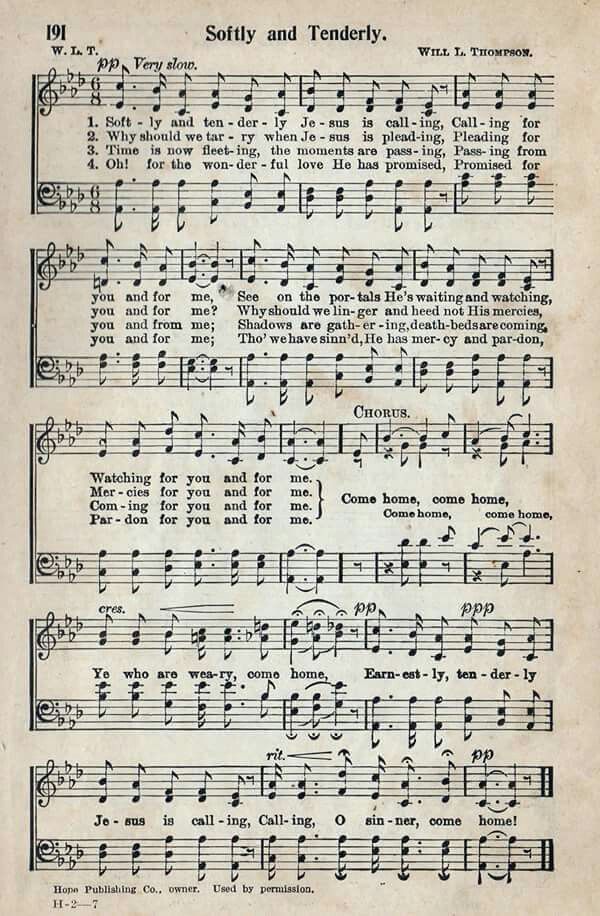
The Origin: A Gospel of Compassion
The year was 1880. Will L. Thompson, a composer of popular secular songs, was visiting D.L. Moody, the renowned evangelist. Thompson, having witnessed the depth of human suffering and the heavy burdens carried by those in Moody’s care, felt a divine urgency to write a song that reflected the heart of God.
He wrote Softly and Tenderly not as a demand, but as an invitation. At that time, many hymns were framed with the fire and brimstone of judgment. Thompson, however, opted for the gentle pull of a shepherd. When Moody eventually heard the song on his deathbed, he famously remarked, “I would rather have written ‘Softly and Tenderly’ than anything I have been able to do in my life.”
It is a testament to the fact that when we strip away the complexities of religion, the core message remains simple: unconditional love is waiting.
The Lyrics:
| Softly and tenderly Jesus is calling Calling for you and for me See on the portals He’s waiting and watching Watching for you and for me Come home, come home Ye who are weary come home Earnestly, tenderly Jesus is calling Calling, “O sinner come home” O for the wonderful love He has promised Promised for you and for me Though we have sinned He has mercy and pardon Pardon for you and for me Come home, come home Ye who are weary come home Earnestly, tenderly Jesus is calling Calling, “O sinner come home” Come home, come home (come home) Ye who are weary come home Earnestly, tenderly Jesus is calling Calling, “O sinner come home” |
The Imagery of the “Portal”
The genius of the hymn lies in its visual language. It does not speak of a throne room or a distant judge. It speaks of a portal—a threshold. This implies that the transition from a state of wandering to a state of belonging is just a step away. The “waiting and watching” depicts a God who is not distant, but deeply invested in the arrival of the soul.
The Acknowledgment of Weariness
The chorus—the heart of the song—is where most listeners find their breaking point, in the most beautiful sense:
“Come home, come home, You who are weary, come home.”
In our culture of “hustle,” we are rarely given permission to be weary. We are told to persevere, to optimize, to do more. This hymn does the radical: it calls out to the exhausted. It recognizes that we carry heavy loads—guilt, regret, broken relationships, and lost dreams—and it offers a place to lay them down.
Why “Softly and Tenderly” Resonates Today
Why, in 2026, does a song written over 140 years ago still feel so relevant?
1. The Universal Need for Belonging
We live in an age of hyper-connectivity, yet report record-high levels of loneliness. The core human need is to be known and to be welcomed back. This hymn articulates the universal desire to return to a state of wholeness.
2. A Gentle Antidote to Anxiety
The rhythm and tempo of the hymn are intentionally slow. They force the listener to breathe. In a world of fast-paced algorithms, this hymn acts as a “spiritual Sabbath,” slowing our heart rate and aligning us with a sense of eternal calm.
3. The Grace of No Deadline
Perhaps the most profound element of the song is the line: “Earnestly, tenderly, Jesus is calling—calling, O sinner, come home!” There is no sense of “too late.” The grace offered in this hymn is timeless. It suggests that as long as there is breath, there is an invitation to begin again.
The Theological Depth: The “Shepherd” Archetype
While the hymn is widely beloved for its emotional appeal, its theological foundation is profound. It leans into the Archetype of the Good Shepherd.
In the Christian narrative, the shepherd is the one who leaves the ninety-nine to find the one. Softly and Tenderly is the musical manifestation of that search. It is an acknowledgment that we are not expected to find our own way back. We are not expected to clean ourselves up before we approach the divine. We are invited to come as we are—weary, laden, and searching.
Reflections on Transformation
Many who have performed or listened to this hymn speak of “the turning point.” It has been sung at campfires, in cathedral pews, and at the bedsides of the dying. It is a song that invites surrender.
Surrender is often misunderstood as defeat. In the context of this song, surrender is victory. It is the victory of letting go of the ego, the pride, and the self-sufficiency that keeps us in a state of isolation. When we sing or listen to Softly and Tenderly, we are essentially saying: “I cannot do this on my own anymore, and I am ready to be found.”
How to Engage with the Hymn Today
If you are seeking to experience the depth of Softly and Tenderly in your own life, here are three ways to practice the stillness it invites:
- The Intentional Pause: Play a classic, instrumental version of the hymn during your morning coffee or evening wind-down. Do not multitask. Simply listen to the melody as if it were a conversation.
- Journaling the “Load”: Use the chorus as a prompt. Write down the burdens you are currently carrying. Visualize the “portal” mentioned in the lyrics and consciously place those burdens at the threshold.
- The Vocal Practice: Even if you do not consider yourself a singer, try humming or singing the melody slowly. The vibration of the voice combined with the intentional breathing required for the phrasing can be a grounding, meditative exercise.
The Invitation Remains
The beauty of Softly and Tenderly is that it does not ask for your credentials. It does not require you to be polished or perfected. It is an open-ended invitation to anyone who has ever felt like an outsider, a wanderer, or a soul in need of restoration.
As the final notes fade, we are left with the lingering truth that love is not something we earn; it is something that finds us. Whether you are walking through a valley or standing on a mountaintop, the call remains the same: Come home.
May you find the peace you are looking for. May you hear the call beneath the noise. And may you find, in the soft, tender spaces of your life, the home you have been searching for all along.
If you found resonance in these words, we invite you to share this article with someone who may need a reminder of grace today. Let us keep the song—and the invitation—alive.